Odds and ends — internet, language, medication and more
There are lots of relatively small questions that do not need separate topics, so I will collect them here. Small, yes... but some of them can cause problems that are anything but small. :)
Internet
Virtually all hotels and most restaurants on local islands now offer free Wi-Fi.
The speed, however, is another matter.
During my island tour in 2024, I tested the connection in many small hotels. In two or three places it was 20–50 Mbit/s, but in most it barely reached 2–3 Mbit/s. I expected things to improve quickly as tourism developed.
There has been progress in the years since, but I still would not advise relying on hotel internet if you need to work or hold video meetings.
For chats, messages and ordinary browsing, it is usually enough.
At my insistence, my favourite place to stay now has Starlink. Among the places I know, though, it is still the only one with Starlink so far. I hope others will follow.
My advice is to arrange mobile internet as well.
At the airport, after collecting your luggage, you will find offices of the two main local operators, Dhiraagu and Ooredoo. You can buy a tourist SIM card, which they will install and set up for you there. Since 2025, Ukulhas has also had a shop where you can buy a SIM card — a licence is needed to sell them. Availability on other islands changes, so check in advance.
If your phone supports eSIM, you can use that option too, including buying one before you travel. For current tourist plans, see the official website of Ooredoo and the page for Dhiraagu eSIM.
Just check how much data the package actually includes and which operator it will use.
Mosquitoes
Here is another question I cannot give a definite answer to.
Are there mosquitoes in the Maldives?
Yes. Except sometimes there aren't. :)
Over the years I have spent two weeks barely seeing a mosquito, then on another trip to the same island been attacked on the very first evening.
What is more, sometimes they are at one end of the beach, while twenty metres further along there is not a single one.
In my experience, mosquitoes are usually no more of a problem than in Bulgaria. Of course, that depends on the island, the weather and the particular period.
I recommend buying a local repellent.
The small shops sell products for 1–2 dollars that have worked very well for me. Bulgarian ones have not always done the job.
And do not underestimate mosquitoes just because there are not many. The Maldives also has mosquito-borne diseases, including dengue. So use an appropriate repellent, especially if you happen to be there when mosquitoes are more numerous.
Language
Maldivians speak Dhivehi.
It has historical links with languages of the Indian subcontinent, but to us it is completely unintelligible.
On local islands, English is the main language used to communicate with tourists.
Younger people usually speak it very well, while older people know enough to make themselves understood to tourists.
The accent is distinctive, though, and sometimes I cannot make myself understood without using my hands.
Mind you, they do not have it easy either: every tourist arrives with their own version of English, and some Europeans' English is a real challenge even for the English. :)
Do not worry if your English is not very good.
The locals are patient and try to understand you. If you are struggling, use a translator on your phone.
And if you want to learn a word or two of Dhivehi, you will always find someone willing to help.
Just be careful what you remember, because they may have taught you something quite different from what you think. :)
Sun and sun protection
The sun in the Maldives is extremely strong.
You can get sunburnt even when it is cloudy, a pleasant breeze is blowing or you spend most of your time in the water.
Use a high-factor sunscreen — SPF 30 or 50+ — whether or not you already have a tan.
Take particular care when snorkelling.
When you swim face down, your back, shoulders, neck and the backs of your legs remain exposed to the sun. Because the water keeps you cool, you can get badly sunburnt without even noticing.
I also prefer to wear a UV-protection shirt.
Medication
Most popular local islands now have pharmacies carrying basic medicines. Ukulhas, for example, also has a medical centre (a hospital is being built), while Rasdhoo has a hospital.
Even so, if you have a condition for which you take medication, bring enough for your whole stay.
Do not assume your particular medicine will necessarily be available on the island.
And take out good travel insurance, especially if you plan to dive or do other water activities.
Drones
You can take incredibly beautiful photos and videos with a drone in the Maldives.
Sandbanks, reefs, islands, boats... The view from above is completely different.
But there is one detail.
You need permits to use a drone in the Maldives.
The process involves approval from the Maldivian authorities and aviation administration, and sometimes the island or resort management too.
In practice, you will see plenty of people filming with drones. That does not mean the rules do not apply.
Take particular care around airports and seaplane routes.
Local people and safety
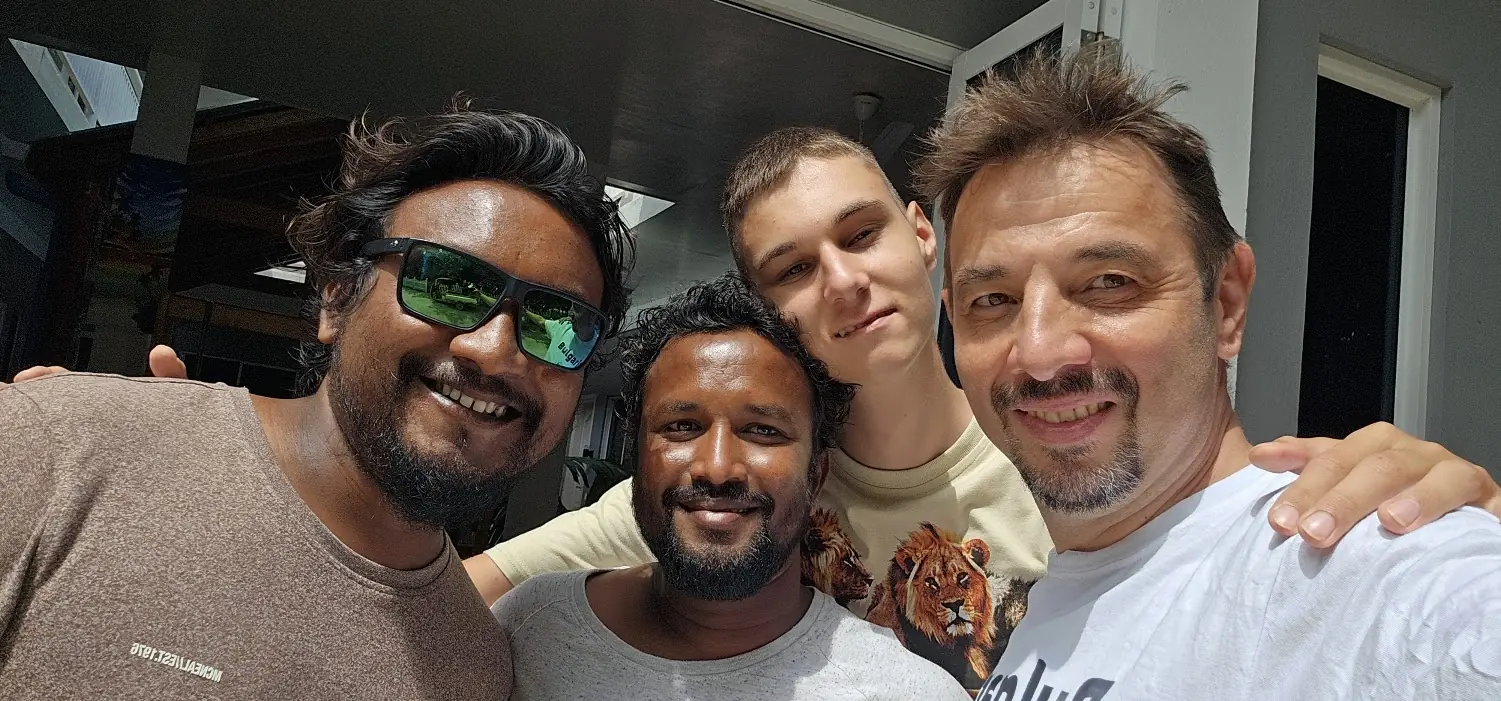
One of the reasons I love the Maldives is the Maldivians themselves.
Calm, friendly and helpful. They are never in a hurry, do not get upset over little things and usually do everything they can to help you.
Sometimes that calm can get on your nerves.
For example, when you have arranged something for ten o'clock and nobody has appeared by 10:15.
It does not necessarily mean they have forgotten you. Their clocks just work a little differently sometimes. :)
My experience of safety has been extremely positive.
In all these years, I have never had an unpleasant incident involving theft.
We have left masks, fins, cameras and bags on the beaches... Sometimes something has even stayed there overnight. It was still there the next day.
That does not mean I am advising you to leave your phone and money unattended.
I am simply sharing my own impression of these people.
And a few more Maldivian quirks
Friday is a day off. Bear that in mind when planning certain services and local ferry journeys.
When parting from local friends, they sometimes just turn round and leave. Without the usual ten minutes of goodbyes we are used to. Do not take it as disrespect.
And if they say “See you”, you probably really will see them. Sometimes ten minutes later, because the island is so small that you cannot help crossing paths. :)
When walking around the inhabited part of the island, dress with local customs in mind. Swimwear is for designated tourist beaches, while more modest clothing is expected in the village.
And do not forget who really rules everyday life in the Maldives.
The ocean.
It decides whether an excursion goes ahead, when the boat leaves, and sometimes even whether you get home on time.
The locals are used to this.
Now we just need to get used to it too. :)